The circuit can be decomposed into 3 stages that have frequency dependent transfer functions (identified by their gray background in the figure), and one ideal voltage buffer stage with a real valued voltage gain .
An answer:
see 6, question Exercise 6.7 .
An answer:
An answer:
Using the specified R and C and using :
An answer:
The loop gain is . Working on this equation can be done of course. But, the explicit hint — both of them — simplifies a lot.
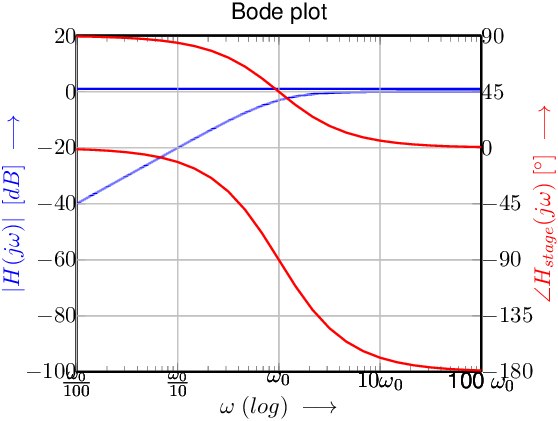
Using the phases of the three stages, it follows that
- the total phase shift ranges from
- the phase shift (change) of the first two stages it twice that of the third stage.
It follows that for there are two possibilities to get :
- some finite close to the in the Bode plot.
There is no way to get harmonic oscillation at the finite solution because the is higher at and hence the solution at that will win. And that’s not regarded as oscillation.
IF you would calculate the finite
solution, then the answer would follow from having to achieve
phase shift in the 3 stages, resulting in respectively (symmetry!)
,
,
phase shift. That
would then result in .
But, sorry, the
wins...
Using the other hint requires rewriting transfer functions to standard form. The three forms would then be:
And the loop gain would then be: which has an imaginary numerator and a complex denominator. This enables relatively easy solving, leading to the exact same findings as before.
An answer:
The same analyses as for the previous question can be used.
Using the phases of the three stages and including the of , it follows that
- the total phase shift ranges from
- the phase shift (change) of the first two stages it twice that of the third stage.
It follows that for there is only one possibility to get :
- some finite close to the in the Bode plot.
For this solution, the 3 stages combined have to achieve phase shift, resulting in respectively (symmetry!) , , phase shift. That would then result in . then follows from equating