Exercise 9.10 An harmonic oscillator with RL and RC sections

(a)
(b)

An answer:
H1(jω) = Av ⋅ jωL∕R 1 + jωL∕R H2(jω) = jωL∕R 1 + jωL∕R H3(jω) = 1 1 + jωRC H4(jω) = 1
(c)


An answer:

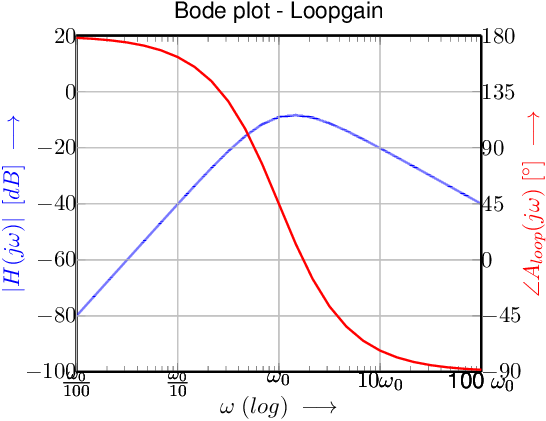
pict

For these plots, ω0 = 1. Asymptotic the |H(jω0)| = 1 = 0dB.

(d)


An answer:
This loopgain has 180∘ phase shift at ω = 0 and has − 90∘ phase shift at ω →∞. Somewhere in the middle, close to ω0, the phase shift of the loopgain is 0∘. Using a well selected Av > 1 the circuit can oscillate harmonically.

(e)

An answer:
Hloop(jω) = Av ⋅ jωL∕R 1 + jωL∕R ⋅ jωL∕R 1 + jωL∕R ⋅ 1 1 + jωRC = Av ⋅ (jωL∕R) ⋅ (jωL∕R) (1 + jωL∕R) ⋅ (1 + jωL∕R) ⋅ (1 + jωRC)

This has a real numerator and a complex denominator. If the denominator is real for a specific non-zero and finite ω then the circuit can oscillate harmonically.

Hloop(jω) = Av ⋅ (jωL∕R) ⋅ (jωL∕R) 1 + jω(2L∕R + RC) + j2ω2(2L2∕R2 + LC) + j3ω3L2C∕R

This is obviously possible for the derived loopgain.

(f)

An answer:
jω(2L∕R + RC) + j3ω3L2C∕R = 0 → ωosc = 0(no oscillation) ωosc2 = 2L∕R + RC L2C∕R (can oscillate)

Substitute this in the next equation to get the required value of Av:

Av = ωosc2(2L2∕R2 + LC) − 1 (ωoscL∕R) ⋅ (ωoscL∕R)
(g)

An answer:
Not applicable.