An answer:
This 3 stages consist of a unity gain voltage buffer that each have their own C-R high-pass
section:
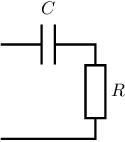
The signal transfer of each voltage buffer preceded by a CR-high pass is:
An answer:
With the previous answer, the signal transfer function for the 3 cascaded sections is:
An answer:
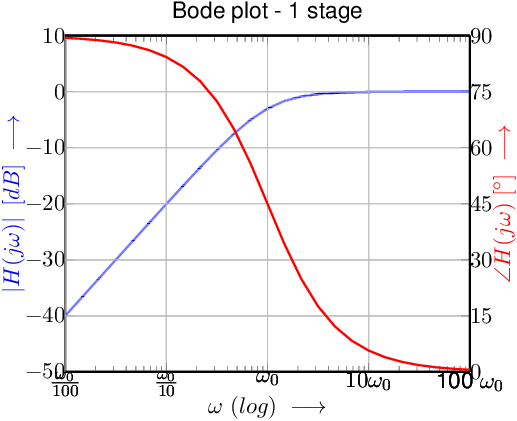
An answer:
Node .
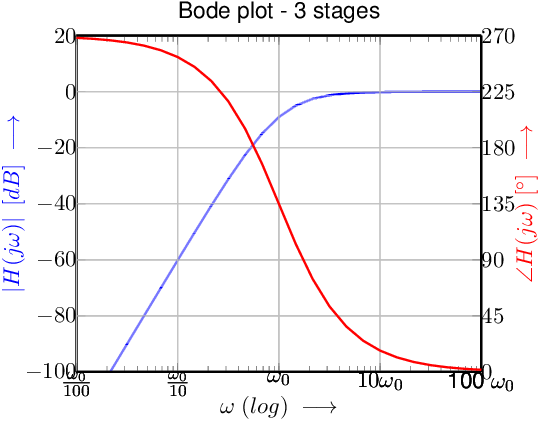
From the Bode pot for the 3 cascaded stages it follows that for oscillation at a finite non-zero
frequency, the gain of the leftmost (amplifying) stage must be negative. There is just one (radian)
frequency at which ;
hence there is no need to check whether other frequencies would be more favourable for
oscillation.
An answer:
An answer:
The voltage gain of the leftmost gain stage must equal -8. For an opamp in negative feedback configuration then .