An answer:
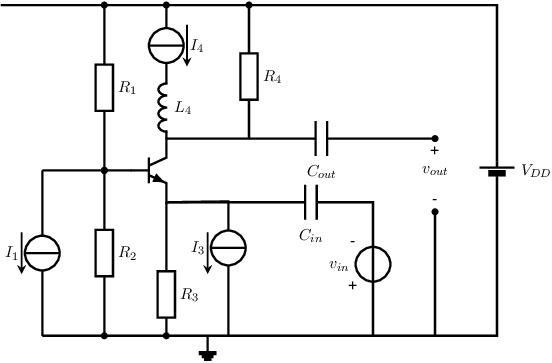
After replacing caps by shorts, inductors by opens, and replacing DC sources by their SS-equivalents:
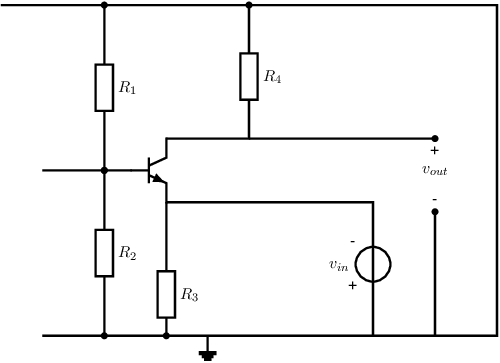
After replacing the non-linear device(s) by their SSEC:
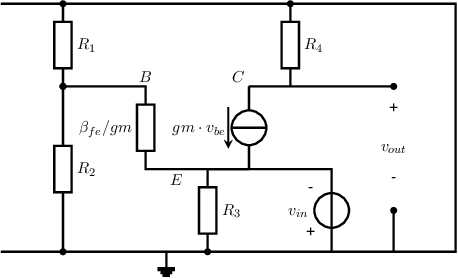
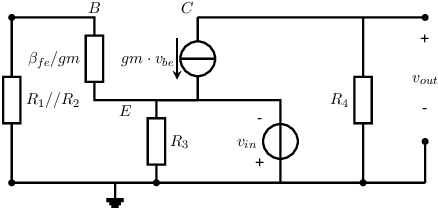
After cleaning up the winding ground wire we get the easiest SSEC:
An answer:
From the small signal derivations should be performed. Note that assuming driving the output port, all other independent sources are set to zero, here ; the other proper way is to use and calculate the unloaded output voltage and the output current if the output is (small signal wise) shorted.
An answer:
For input impedance, the sign of the is irrelevant, according to Ohm. Because the base (in this SSEC, for this circuit) is NOT shorted to SS-ground, the small signal base voltage is NOT zero. This is different from the simplified situation that is frequently used. Tying the base to ground is wrong for this circuit. A proper derivation (one of many proper ones) is:
An answer:
A derivation (one of many) is: